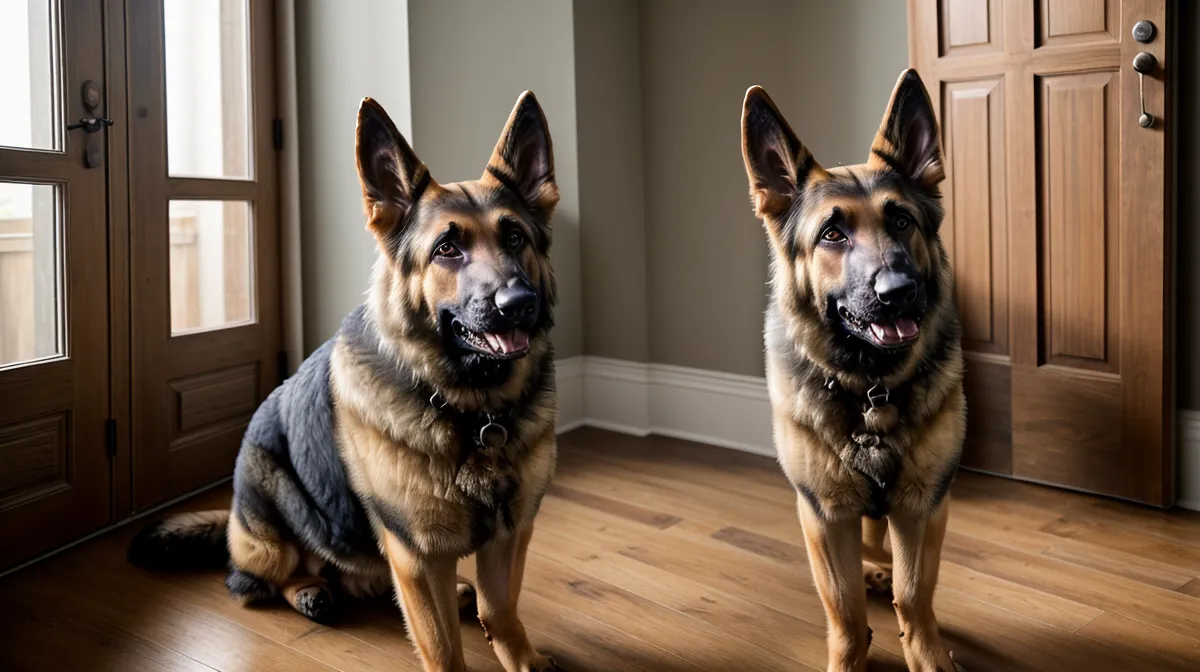
Banjo was pacing a tight, mechanical circle between our kitchen island and the front door, his head dropped low. When he stopped, he didn’t lie down. He simply stood with his nose pressed against the hinge side of the door trim, staring at the painted wood. It was well past midnight, and I had no idea how to explain that over a screen.
As a UX researcher, I spend my working days studying human friction points, but sitting on the floor in my socks watching my nine-year-old shepherd mix, I felt completely out of my depth. For weeks, I had convinced myself he was just having an off night or that his back legs were stiff from an afternoon chasing Pickle around our sloping yard. But that night was different. Banjo's nails clicking rhythmically across the hardwood hallway in a repetitive loop late at night, followed by the dull thud of his nose resting against the pantry door, became a routine I couldn't ignore.
The problem was the timing. My local vet clinic in Asheville was booked three weeks out for routine exams, and an emergency hospital waiting room at 1:00 AM felt entirely wrong for a dog whose crisis wasn’t acute bleeding or collapse, but a slow, quiet drifting of his internal compass. That was when I booked a virtual triage consult through our pet telehealth provider, Maven Pet, hoping a set of trained eyes could watch his movements in his own territory without the white-coat adrenaline that masks everything in a clinical lobby.
The Myth of Memory Loss: Why We Miss the Early Clues

When most of us worry about cognitive dysfunction syndrome in an aging dog, we picture canine Alzheimer’s in the most dramatic sense: a dog who forgets his own name, fails to recognize his family, or forgets where his food bowl sits. Because Banjo still greeted me with a thumping tail whenever I walked into my office and still sprinted to the back door when I rattled the leash, I assumed his brain was sharp.
Focusing solely on memory loss often causes owners to miss the more subtle, earlier indicators of cognitive decline like changes in depth perception or increased sound sensitivity. In Banjo's case, the earliest cracks in his routine weren't about forgetting who I was; they were about how he negotiated physical space and environmental stimuli. One damp evening last February, I noticed him pausing awkwardly at the threshold where the light maple hallway meets the dark slate tile of the bathroom, lifting his front paw as if trying to step over a chasm. A few days later, a low rumble of thunder that used to elicit nothing more than a lazy ear flick sent him trembling into the tight, dusty crevice between the washing machine and the dryer.
A vet evaluating your dog over video cannot palpate a spine or run bloodwork through the camera. What they can do—if you know how to show them—is observe spatial orientation and perceptual shifts in the environment where your dog spends twenty-four hours a day. When you hop on a call to talk about aging, you have to shift your focus from 'Does my dog remember me?' to 'How does my dog interpret his immediate surroundings?'
Structuring Your Observations: The 5 DISHA Markers
If you get on a fifteen-minute video call and simply tell a remote veterinarian, 'My dog is acting weird lately,' you will spend half your appointment answering basic screening questions. To make virtual care actually work, I had to learn to translate Banjo’s late-night quirks into the clinical framework veterinarians use: the standard DISHA evaluation categories.
DISHA breaks cognitive changes down into five distinct behavioral categories. Walking into your call with notes organized around these specific pillars immediately elevates the conversation from vague worry to actionable clinical triage:
- Disorientation: Does your dog get trapped behind open doors, pace into corners and freeze, or stare blankly at walls? Note whether they hesitate at transitions between different flooring surfaces or struggle to track treats dropped right in front of them.
- Interactions: Has their social connection with you or other pets shifted? Banjo didn't become aggressive, but he became strangely aloof around our beagle, Pickle, often stepping directly on her bed while she was sleeping in it as if she weren't there.
- Sleep-Wake Cycles: Is your dog sleeping deeply through the afternoon only to wander restlessly between midnight and 5:00 AM? This night-waking pacing is frequently the clearest flag of inverted circadian rhythm.
- Housetraining: Are there indoor accidents occurring without any underlying bladder infection, or does your dog ask to go outside, wander out into the grass, and then immediately return indoors to urinate on the rug?
- Activity Changes: Look for both extremes: aimless, repetitive pacing and compulsive licking, or a profound loss of exploratory interest in familiar surroundings.
Before my consult, I had written out specific examples under each category in my journal. Being able to report that Banjo scored positive on three of the five DISHA categories gave the telehealth vet an immediate baseline before she even asked to see Banjo move.
Setting the Scene: How to Frame Your Telehealth Camera

Most pet telehealth calls fail visually because owners hold their phones at chest height, aiming down at their dog curled up on an orthopedic bed. A sleeping dog tells a vet almost nothing about their cognitive status. If you want the clinician to spot motor planning deficits, response latency, or sensory hesitation, you have to build a functional observation stage.
I learned this during our second consult after about two weeks of collar tracking. Instead of balancing my phone, I set my laptop directly on the living room floor against the sofa, angled slightly downward to capture a wide-angle view of the hallway doorway and the kitchen threshold. I made sure the overhead lights were on so there were no harsh shadows distorting depth.
When the vet joined the call, I didn't call Banjo over to the screen. I left him alone in the kitchen, then dropped a hollow marrow bone near the living room rug. What the vet watched was Banjo’s response latency—the exact number of seconds between the auditory cue and his decision to turn his head—and his unprompted corner navigation. As he moved through the doorway, the vet immediately caught him hesitating at the wood-to-tile seam, pausing for several beats to test the ground with one paw before committing his weight.
For more logistics on getting your room and gear set up before the screen lights up, I detailed the technical side in my notes on How to Prepare for a Virtual Vet Appointment for Senior Dogs, which covers everything from lighting angles to managing multiple pets during the call.
Backing Video with Sensor Data
Subjective notes are helpful, but hard numbers keep a virtual consult grounded in reality. One of the biggest challenges with senior dogs is differentiating joint stiffness from cognitive restlessness; a dog waking up at 3:00 AM might be pacing because his hips ache, or he might be pacing because his brain's internal clock is misfiring.
To separate the two, I leaned heavily on Maven Pet's 24/7 continuous sensor tracking collar. Because the collar hardware logs micro-movements, scratch frequency, resting intervals, and active minutes continuously without relying on manual entry, it generated an objective sleep fragmentation curve. When I shared the app's dashboard over screen-share during our visit, the vet didn't just see a tired dog; she saw a quantified breakdown showing Banjo's sleep had fragmented into twenty-minute bursts followed by ten minutes of wandering, happening like clockwork between 2:00 AM and 4:30 AM.
When combined with the fact that his daytime scratch count and mobility scores had remained steady, the clinician felt confident that we were dealing primarily with neuro-behavioral disruption rather than acute orthopedic pain spikes. Having that continuous tracking data eliminated the guesswork, allowing us to build an immediate management plan rather than wasting weeks on trial-and-error.
The Legal Realities of Telehealth and Next Steps
It’s important to understand the legal scope of what a virtual appointment can and cannot provide. Depending on the state where you live, the Veterinary-Client-Patient Relationship (VCPR) regulations dictate whether a telehealth veterinarian can formally diagnose canine cognitive dysfunction or prescribe prescription medications like selegiline.
In our case, the telehealth vet served as an invaluable triage and prep partner. She walked me through an environmental modification checklist—adding high-contrast runner rugs across our slick floors, leaving a soft nightlight near the water station, and introducing specific antioxidant support—while generating a concise clinical summary of the DISHA markers and collar data that I could hand directly to our local brick-and-mortar vet.
When Banjo finally had his in-person physical in late spring, my local vet reviewed those virtual intake notes, confirmed there were no occult metabolic causes like liver or kidney spikes driving the confusion, and smoothly initiated targeted senior care. If you are also juggling managing daily medications or supplements alongside mobility care, you might find my breakdown of My Experience Using Online Pet Pharmacies for Chronic Senior Dog Pain helpful for keeping refills predictable and affordable.
Spotting senior cognitive decline isn't about waiting for your dog to forget your face. It's about paying attention to the quiet moments: the hesitation at a familiar doorway, the sudden startle at an everyday sound, the late-night loop across the hardwood floor. Bringing those specific moments to a telehealth vet with the right camera angle, documented DISHA categories, and objective tracking data turns late-night panic into a calm, proactive baseline for your dog's golden years.